He only had one lung & I have questions.
And why it made me think about every creative thing I've ever talked myself out of.
Nobody ever really explained to me why he only had one lung. Maybe it was cigarettes. Maybe his stint in WWII. Regardless, my grandpa never seemed to be overly concerned about it.
Harold, or Hal as he was known by his friends, managed a grocery warehouse by day and played golf every afternoon…weather permitting. He kept his clubs, maybe 30 of them, hung upside down and equally spaced out along three walls of a dedicated basement room in his house.
I would often sneak down to that dark room and touch the multi-colored headcovers—some fuzzy, some leather, and some knit like small socks—more curious about those covers than the actual game of golf.
To get to that room, I had to pass his workbench, which sat at the bottom of a wooden staircase with a hairpin turn in it. The same staircase that I had slipped down in my bright red leatherette boots when I was barely past kindergarten.
His workbench was lit by a single lightbulb from a pull chain. The wood was worn and paint splattered. Tools and knickknacks were always strewn about. I don’t remember him putting those tools to any great use but I do remember his collection of naked troll dolls, each with different colored hair, that sat on the top shelf.
I also know he sat at that workbench and wrote silly letters to me in his distinct block handwriting. Letters that read:
“Helloooooo...I looked for you in the mailbox today but no one was there.”
In my mind, he was always smiling and singing made-up songs with his gravelly one-lung voice to make us laugh. And, except for the fact that he and my grandma slept in twin beds pushed together, those are all of my memories of him. Just a handful from only a small part of his life.
He died when I was ten but I’ve always wished I’d known him more.
Why did he have so many golf clubs? What was he like as a teenager? Why did he only have one lung? How did he get such perfect handwriting? Why the naked troll dolls?
Years ago, I was helping my mom sort through things in her storage closet. I came across a box that, judging by the crisp, yellowed packing tape barely holding it shut, had not been opened for decades. Inside were albums from my mom’s childhood along with loose photos that had been tossed in there.
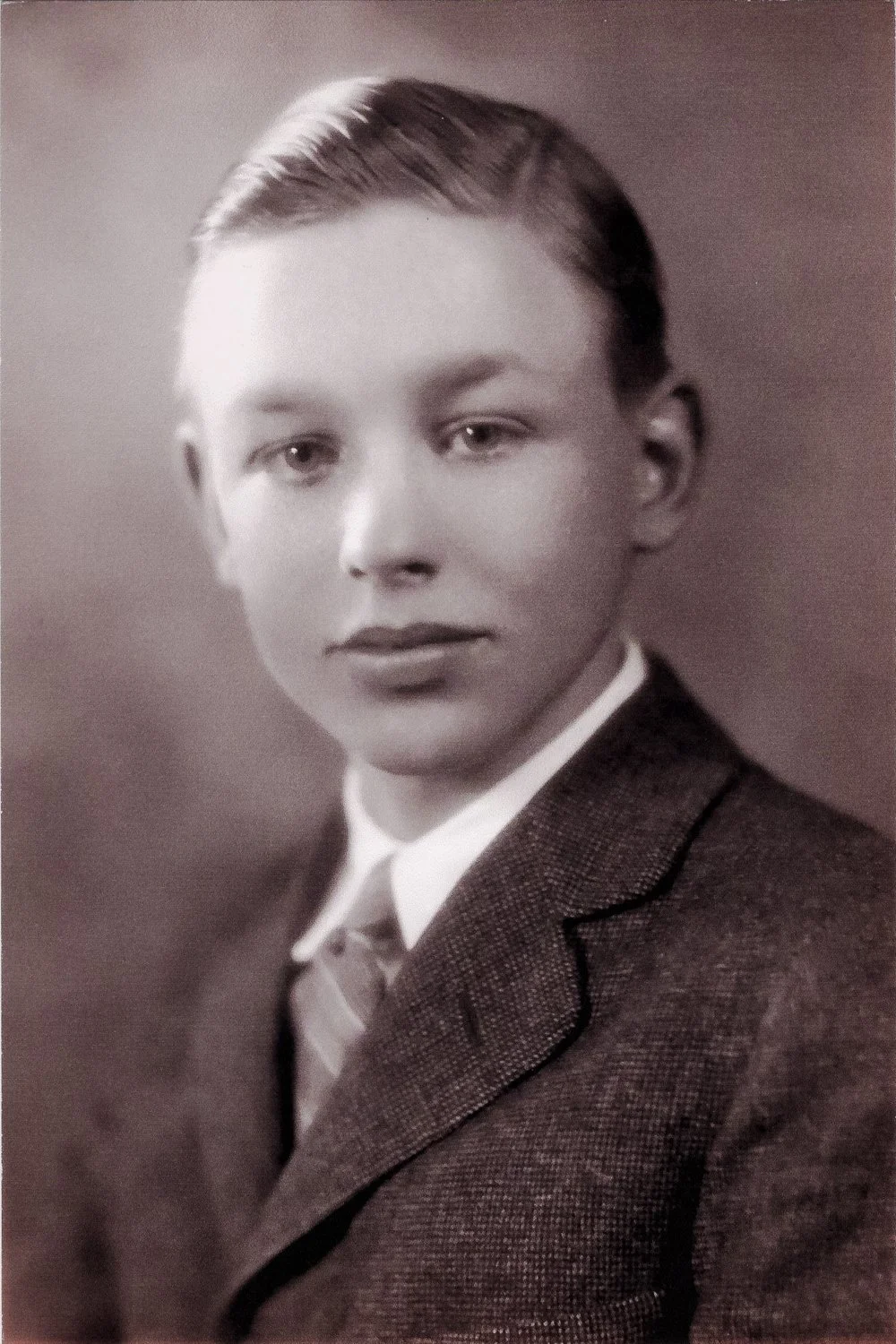
I thumbed through various photographs. Many faded and out of focus. Photographs of people I didn’t know or didn’t recognize. And then I came to a photograph unlike the others. A rectangular photograph, mounted on a mat board, and fully in focus. A portrait of a young man in a suit and tie. Eyes bright. Clean shaven. Maybe around the time this man was headed off to college.
I flipped it over and, written in his distinct script, I read, “Harold Rice.”
My grandpa.
I stared at the face that I would only know decades later. Happy to have this glimpse of him as a young man. The smile. The same eyes with the turned-down corners. The smart suit. And the hairline that foreshadowed the mostly bald grandfather I would love so much.
Grateful that he, or more likely his mother Grace, had carved out the time to have his portrait taken. One that would last for generations—literally. And one that would help his granddaughter piece together more of who her grandpa had been before she knew him.
As I held that photo, it occurred to me how close it made me feel to a man I really didn’t know well. How it brought back the sound of his singing, and yet, I wouldn’t have that photo, that closeness…without the photographer who took it.
I don’t know who took it. I’ll never know. But someone did. Someone took the time to pose him, to focus the camera, to have him sit very still while the shutter whirred, to develop the image in a dark room.
And this photographer could not have foreseen the effect of his work a hundred years later. The way his afternoon spent with my grandfather over a century ago would still be meaningful today.
Which makes me wonder how often we talk ourselves out of doing something because we can’t see where it leads.
If I can’t make the “xyz” best seller list, why write anything? If I can’t photograph people like Annie Leibovitz, why photograph anyone?
The photograph of my grandfather didn’t change the world. But it changed something for me.
I came across this quote recently.
“Your purpose is not the thing you do. It is the thing that happens in others when you do what you do.”
Perhaps some of the most meaningful things we do are the ones that touch the lives of people we’ll never know.
And that may be the best reason to do anything. Maybe you feel the same way.
Cheers,
Carrie